AI Treasury
Stack
Stack grew from a manually incubated BTC and ETH treasury strategy into an application used by hundreds of customers throughout a market cycle. Live since February 2023, Stack is now applying those product, customer, and operating lessons as it expands from human treasury owners to AI agents.
Visit Stackit.ai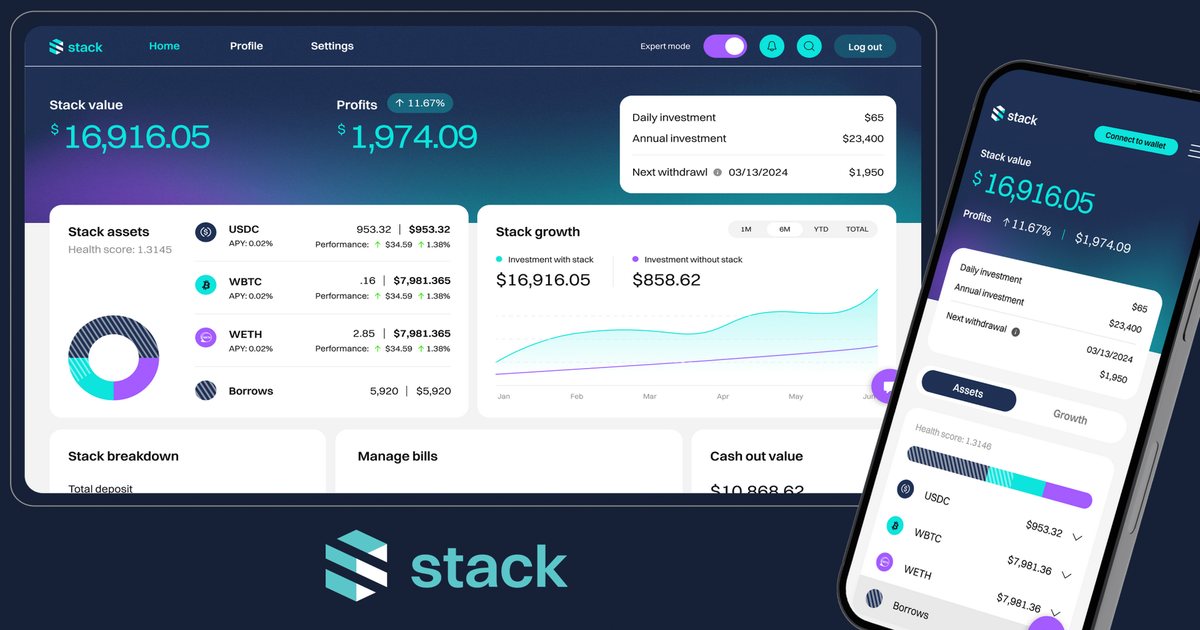
Feb 2023
Live since
Blockchain-confirmable live date; public on-chain fees began that month
$10M
Historical assets inside Stack
Historical platform milestone; not a current balance
≈$40K
Peak monthly recurring revenue
Historical peak; not current MRR
Hundreds
Customers throughout the cycle
Historical operating scale; not a current customer count
The operating product
A treasury operating system—not a financial-content experiment.
Stack turns cashflow into a protected BTC and ETH position, makes borrowing part of a defined strategy, and uses rules to respond when markets rise, fall, and recover.
Protected leveraged DCA
Deposits convert into BTC and ETH over time using controlled leverage and explicit operating bands.
Automated protection
When markets fall, the rules engine can repay debt and reduce risk before a position reaches a fragile state.
Borrow without selling
Treasury owners can borrow against long-term holdings for operating needs while keeping the underlying position.
Recovery loop
After defensive deleveraging, the system can re-enter its target range as markets recover instead of relying on manual rebuilding.
Humans + agents
Built for humans first. Now actively used by agents.
Stack is a product-creation story measured in market cycles. Mass Ideation incubated the strategy by operating and testing it manually through the first cycle. Those results showed it worked, so Stack launched as an application in the second cycle and served hundreds of customers throughout the cycle. That produced extensive product, customer, risk, growth, and operating learning. Now, during the third cycle's bear market, Stack is applying those accumulated lessons while adding AI agents as a second customer class. Preparing the live product so agents could discover it, understand it, trust it, and safely use it became the practical foundation of Mass Ideation's AI Readiness program. Stack continues to serve humans, and agents are already using the platform.
Agents can inspect, simulate, monitor, and prepare treasury actions. Human-defined policy, permissions, limits, and signatures remain the boundary for real funds.
Agents in production
AI agents are already using Stack while the platform continues to serve its human treasury customers.
MCP-native
Claude, GPT-compatible clients, and other MCP agents can discover Stack treasury tools directly.
REST + sandbox
Agents can inspect treasury state, simulate actions, monitor risk, and test workflows before live access.
x402 access
Wallet-sovereign agents can use pay-per-request authentication without a traditional API-key signup loop.
Rules before execution
Hard limits, typed safety errors, scoped permissions, audit trails, and unsigned transactions keep operators in control.
Why the Growth Engine exists
Stack could not buy its way to growth.
Stack could not rely on conventional paid advertising. Because it operated in blockchain and crypto, category restrictions closed or sharply limited the acquisition channels most companies use. Mass Ideation had to build a different system: earn attention through education and useful tools, turn trust into qualified conversations, improve onboarding and customer experience, and let product and market evidence shape the next cycle. That necessity became the AI Growth Engine.
AI Growth Engine in practice
A complete system that gets operated, measured, and improved.
- 01
Awareness
educational content, treasury guides, public tools, and agent documentation
- 02
Lead Capture
borrowing guides, product interest, and treasury design calls
- 03
Sales
a consultative process that maps cashflow, goals, rules, and risk constraints
- 04
Customer Experience
guided setup, dashboards, APIs, monitoring, and transparent safety rails
- 05
Loyalty
an operating treasury designed to become more useful as customers continue depositing and borrowing
- 06
Learning
market behavior, product usage, risk events, and customer questions inform the next iteration
- 07
Optimization
offers, onboarding, automations, protection rules, and agent interfaces improve from that evidence
What the product proves
Operating experience changes the advice we give.
Protected BTC and ETH treasury
Automated risk and borrowing rules
Human and AI-agent operations
Evidence note — Product capabilities and operating claims are drawn from Stackit.ai's public website and agent documentation. The February 2023 live date is blockchain-confirmable through publicly verifiable on-chain fee activity. Hundreds of customers throughout the cycle, the $10M historical asset scale, and approximately $40K peak MRR are historical operating milestones; none is presented as a current figure.
The client connection